
Searching Navarro County Criminal Dockets
Start at the official Navarro Odyssey public-access endpoint. The clerk sites both point to it as the local route for a docket search. A 2026 check on September 3 returned an HTTP 403 error. So the portal's exact fields remain unconfirmed. That error is not proof your case is missing. Fall back on the clerk if the portal blocks you.
Before you search, collect the full name, court, case category, and case number if you have it. Names repeat in a county this size. Match the court, filing date, and charge before you trust any result from the criminal docket.
- Identify felony, Class A or B misdemeanor, fine-only, or municipal jurisdiction.
- Try the local portal and save the search date.
- Check re:SearchTX for eligible statewide material.
- Call or visit the correct clerk if coverage is unclear.
- Request a plain or certified public copy when the docket is not enough.
Navarro Criminal Docket Record Desk
Misdemeanor records at the county level sit with the Navarro County Clerk. Its criminal work covers Class A and B misdemeanors such as DWI, theft, assault, and drug cases. The criminal department works out of Suite 101 at 300 W 3rd Avenue, Corsicana. Counter hours run 8:00 a.m. to noon and 1:00 to 4:30 p.m. Call 903-654-3035. Mail goes to P.O. Box 423, Corsicana, TX 75151-0423.
The County Clerk page also handles warrants, summonses, bond forfeitures, subpoenas, and commitments. Those stand apart from the docket itself. An entry may point to one of these items without showing its full text. So ask for the precise item, the case number, the court, and the date range. Say whether a plain copy works or whether you need a certified one. The clerk's no-cost misdemeanor copy exception covers the District Attorney. It also covers the defense attorney of record. That is not a public fee waiver.
Inside a Navarro Criminal Docket
Think of a Navarro County criminal docket as an event index rather than the whole file. A JP3 pre-trial sheet, for instance, opens with the date, the court, the judge, and the court date. Columns then run through Type, Time, Court Date Type, Case Number, Offense or Action, Name, and Plaintiff or Complainant. Other courts arrange their records in their own ways.
| Case number | A court identifier; the JP sample uses a CR type code. |
|---|---|
| Charge or action | The stated offense or scheduled event, subject to change. |
| Setting | Date, time, and type, such as PRETRIAL. |
| Plea or filing | An event recorded after clerk processing, when public. |
| Disposition | The recorded outcome, not a pending setting. |
Work down the rows in order. A hearing date tells you nothing about guilt, dismissal, or sentence. When the outcome matters, ask the clerk for the judgment.
Navarro Felony Criminal Docket Route
Felony cases belong to the District Clerk and the 13th District Court. That is the county's only general-jurisdiction district court. Joshua B. Tackett serves as District Clerk. The office sits in Suite 201 at the courthouse. It keeps weekday hours of 8:00 a.m. to 5:00 p.m. Call 903-654-3040.
The 13th District Court page gives the court's identity, local rules, and forms. Its coordinator handles questions about settings and court process. For district case files, the District Clerk is where the buck stops. Filter or request by "13th District Court" to stay on target. If a docket points to reporter-held material, ask how transcript requests are routed. Reporter records can carry a different custodian, charge, and production process.
For statewide context, the OCA felony activity criteria show how court statistics get selected.
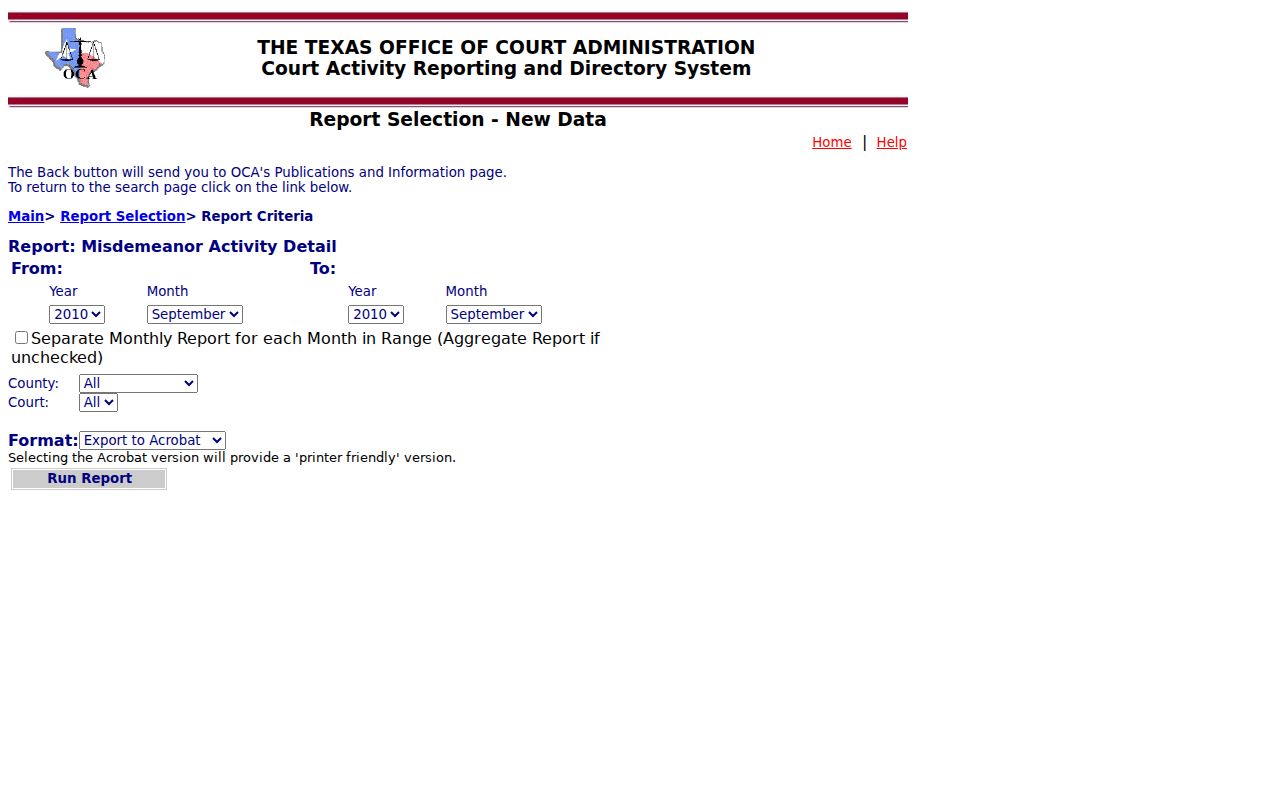
That report screen counts cases; it does not look one up by name. For the actual Navarro County criminal docket, stick with the District Clerk.
How a Criminal Case Moves
The usual docket flow is Charge Filed › Arraignment › Pretrial Settings › Plea or Trial › Disposition › Sentencing. Not every case uses each stage. Navarro County forms add terms such as waiver of arraignment, trial announcement, jury waiver, plea packet, revocation, agreed continuance, and trial-court certification. Each describes a filing or stage, not an outcome by itself.
County Court at Law procedure adds a local wrinkle. Criminal dockets usually happen in person, though a jailed defendant may appear by Zoom. Plea papers must be e-filed before anyone requests a setting. An incomplete packet comes back. So a plea date may not show up until the papers clear that step. Once a plea is set, the posted procedure gives the State 48 hours to e-file the judgment. That is why a setting, a plea event, and a judgment can land on the docket at different times.
Navarro Criminal Docket Setting Terms
A PRETRIAL label shows what is set, not how the charge ended. An appeal certification is likewise just a document type, not proof of any appellate result. Hunt for a judgment, dismissal, sentence, or other final entry. If none appears, confirm with the clerk. A docket label alone settles nothing.
- Arraignment
- A stage where the charge and plea are addressed.
- Pretrial
- A setting before trial for motions or case management.
- Continuance
- A court-approved move to a later date.
- Revocation
- A proceeding tied to alleged breach of release or supervision terms.
- Disposition
- The recorded result of a case or charge.
Note: Navarro County docket labels take their full meaning from the related order, form, or judgment.
Courts That Hold Criminal Dockets
Criminal cases in Navarro County split up by offense level and court. The 13th District Court takes felonies. Misdemeanors run through County Court and County Court at Law, and the County Clerk keeps the files for County Court. Four justice courts handle fine-only cases and post selected Criminal and Pre-Trial docket views. Municipal courts, in turn, handle Class C and city-ordinance cases inside city limits.
For a JP matter, go by the precinct printed on the citation or notice. All four justice courts share one address, 312 W 2nd Avenue, but each has its own judge and phone number. The Navarro JP page gives contacts, calendars, forms, and docket links for every precinct. A city citation may sit in a separate payment system and never show up in the county portal. Let the court named on your paperwork drive the docket search. Proximity alone is a bad guide; do not pick a clerk just because the office sits near where the incident happened.
Navarro Criminal Docket Coverage Gap
re:SearchTX offers Cases, Filings, Text, and Hearings modes for searching. Filters cover location and case type. It sounds complete. It is not. A Texas judiciary data report states plainly that criminal records sit outside the statewide repository. Access is role based, so restricted documents stay off limits. Anyone running a Navarro County criminal docket search should treat the statewide system as a second layer rather than a substitute for the clerk.
Navarro Criminal Docket Copy Requests
Sometimes the docket entry lacks the document itself. Send a narrow written request to the right custodian. For County Clerk material, the published public-record email is ccor@navarrocounty.org. Name the court, the case number, the record type, and a date range. Request public docket entries and filed orders only, leaving out restricted material. Add a delivery preference. Say you will pay lawful copy and postage costs.
Never mail a Social Security number, full driver-license number, or date of birth just to identify a file. Leave out payment data and protected addresses too. Rule 12 does not force a judicial-record custodian to build a new database. Court case records, judicial administrative records, and county administrative records are distinct. Each can follow a different access route.
Sealed Dockets and Public Access
Texas court records start open. Rule 76a of the Texas Rules of Civil Procedure presumes public access. Yet its own test and process allow a judge to seal a file. Other laws narrow things further. Family Code Chapter 58 locks down juvenile records. Protective-order law can shield a home address or other sensitive facts. A case shell may appear in a docket search. That does not make every attachment public. The flip side holds too. A file you cannot see does not prove nothing was filed.
Access rules: The Texas judicial open-records policy explains why court records do not use one ordinary TPIA process. Rule 12 governs many judicial records other than case records. Ask the originating clerk which route controls.
Put the Navarro County criminal docket to work. Locate a case, confirm a hearing date, read the filings, or request an official copy from the clerk. Redactions are lawful access at work, not a broken record. Still, never republish personal identifiers pulled from a docket PDF. Verify the key facts first. The clerk who holds the original file can confirm them.